Cost of the Closure
14/9/26 US/Global DeskThe Buyback FailedIwo Wojcik US Prices in America went up more than expected last month. Core CPI MoM (the measure of inflation, tracking how much prices are rising for everything except for food and energy) came in at 0.3%, against the expected 0.2%. Meanwhile, headline CPI came in at 0.4% month-over-month and 3.4% over the year, on target with analysts' expectations, meaning the surprise was entirely in core. This turned heads, increasing the odds of a rate hike from 70% to 90% in just one morning. When prices rise too fast, the Fed, in turn, raises interest rates in order to make borrowing more expensive, slowing down spending and cooling prices. The Fed has held rates between 3.50% and 3.75% for all of 2026. This Wednesday would be the first move in almost 12 months, the first hike since 2023. Though the annual figure improved (2.4%), the Fed isn't looking at last year's inflation. They're looking at where it goes next, and this new data means the outlook just got worse. The key problem we have here is that the Hormuz shutdown is now rippling into the core, even though it excludes energy. Diesel moves cargo, and jet fuel moves planes. We are now seeing data reflecting that airfares just rose 2.7%, and transport services rose 0.5%. And shelter, which had been cooling down for almost two months, is now back up to 0.3%. The shock of the week
This week, we saw the 10-year Treasury yield hit 4.97%, the highest it's been since October
2023. This number matters because loans across the whole economy are priced off it: mortgages,
company borrowing, everything. 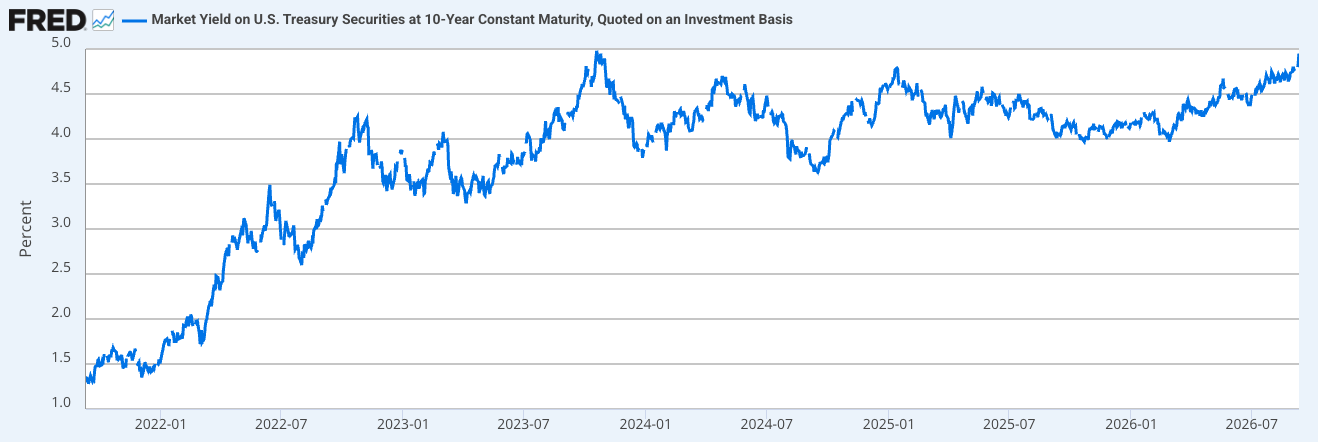
10Y yields - Board of Governors of the Federal Reserve System (US) via FRED® Global Outlook As of this month, it has become clear that a global tightening has commenced. Looking forward, energy markets will continue to dominate the ebb and flow of the global economy. While inflation projections earlier in the year anticipated a simple peak and then disinflation, this hasn't held up, and inflation is re-accelerating in many economies. Namely, Swiss inflation came in at 0.8%, the highest in 2 years, and Australia has raised three times this year to 4.35% and markets price roughly 80% odds of another on the 29th of September. The ECB hiked 25bps on Thursday. While bond yields have been in headlines for some time now, their surge is accelerating, and producing new headlines daily. Last Thursday almost shook the US 10Y above 5%, pushing some yields up by double digit basis points in a single day, as inflation runs hot globally and deficit spending remains persistent. Some headlines you might've missed The IEA cut its 2026 oil demand sharply, reflecting the largest contraction since COVID, while simultaneously flagging supply destruction risk from the war. The annoying part for energy markets is the parallel between supply and demand both deteriorating simultaneously. On the AI front, Dario Amodei published an essay calling for the industry to slow down model development, following a high-profile employee resignation. OpenAI's Sam Altman was in agreement. Switzerland's Novartis also plunged 10% in a single day last week, as another round of failed drug tests weighed on its own outlook UAE/Gulf DeskHormuz Leads the PackHenry de Salis An escalation in the Strait of Hormuz this week clearly drove all of the movements across the Gulf. Up until last week, while tanker traffic was essentially zero, oil pipelines in the UAE and Saudi Arabia carried a large portion of the load. That changed in the second half of last week, when the Saudi east-west pipeline was struck by an Iranian-backed proxy. The uncertainty now is whether Saudi will be able to divert oil shipments through other pipelines, or if they are able to make repairs quick enough. Regardless, oil is likely to gap up on Monday open, with Brent closing at $104 on Friday, the highest since July. The primary alternative export route for oil is now destroyed, and with the largest wave of attacks on tankers in Hormuz since the war began, it will be difficult for markets to price in anything remotely close to a 'quick re-opening'. 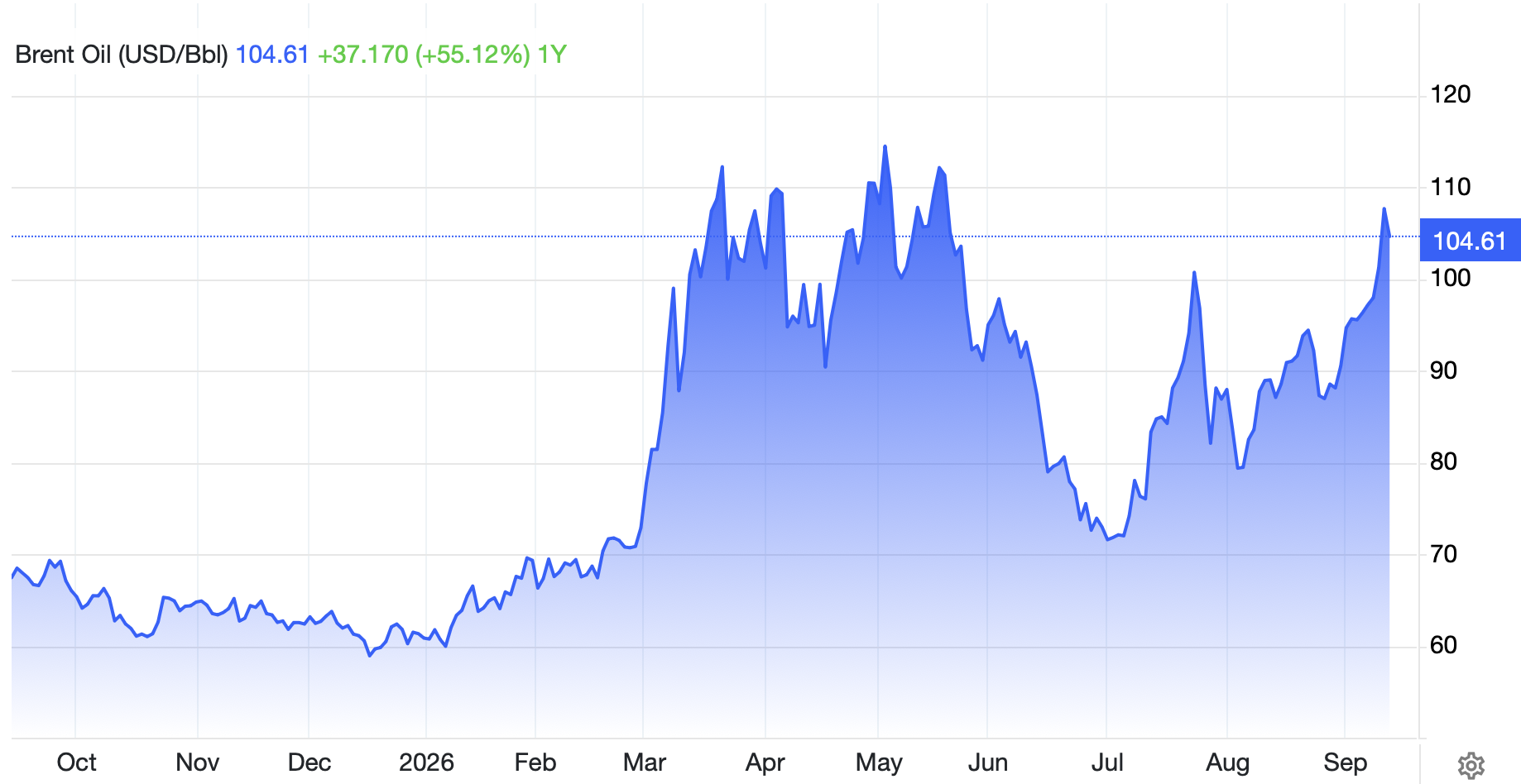
Brent Crude ($/Barrel), TradingEconomics UAE In the UAE, stocks actually rose because of the oil scare. Abu Dhabi's stock market index was seen higher last week, recovering about half of the losses since the beginning of the war. Dubai's index also rose 1%, compared to Abu Dhabi's 1.4%. Confidence is robust: Dubai's International Property Show ran earlier last week, with over 300 exhibitors and 30,000+ attendees. The National reported transaction volume falling tangibly, although this allegedly reflected a maturing property market rather than anything to worry about – noting shifting demand towards lower cost property brackets. Gulf Saudi Arabia's stock market index was choppier, and seen broadly lower, where banking stocks (Al Rajhi, SNB) were the main support throughout the week. Positively however, Gulf carriers kept flying on schedule, as hub traffic through the Gulf remains stable but subdued. Qatar, Kuwait, and Bahrain's markets were seen even softer, as a risk-off continues through the escalation. Gold While the Federal Reserve is expected to hike rates this week, which should negatively affect gold, there was actually the opposite happening. Dubai's gold prices jumped as Hormuz escalated, showing that safe-haven demand counteracted the hike risk. Outlook Here's the overall outlook: this isn't just Hormuz. The Gulf's broader peg to the Dollar means that interest rates will rise across the Gulf if the Fed decides to hike this week. Beyond that, we will closely watch how Saudi Arabia handles the Houthis, who have gained increased leverage over the region. Their seizure of ports in the Red Sea though, for now, has done little to affect supply. Hormuz is already closed. The question now is whether Saudi's pipeline, and the Red Sea are too. Read online at twodesksnewsletter.com This is not financial advice. Read our disclaimer.
Henry de Salis 
Copyright 2026 Two Desks. All Rights Reserved. |