Ceilings & Crossfire
12/10/26 US/Global DeskThe Yield Ceiling?Iwo Wojcik Up and up and up. For the last four issues, yields have been climbing. This week the 10Y was the highest since April 2002 and then fell back to around 5.24% by Friday, down from last week. The 30-year is still near 5.6%. This means borrowing costs are still high, but the sell-off that started in September is finally showing signs of slowing down. The question now is whether this will mark the top or just a retrace before they push higher. 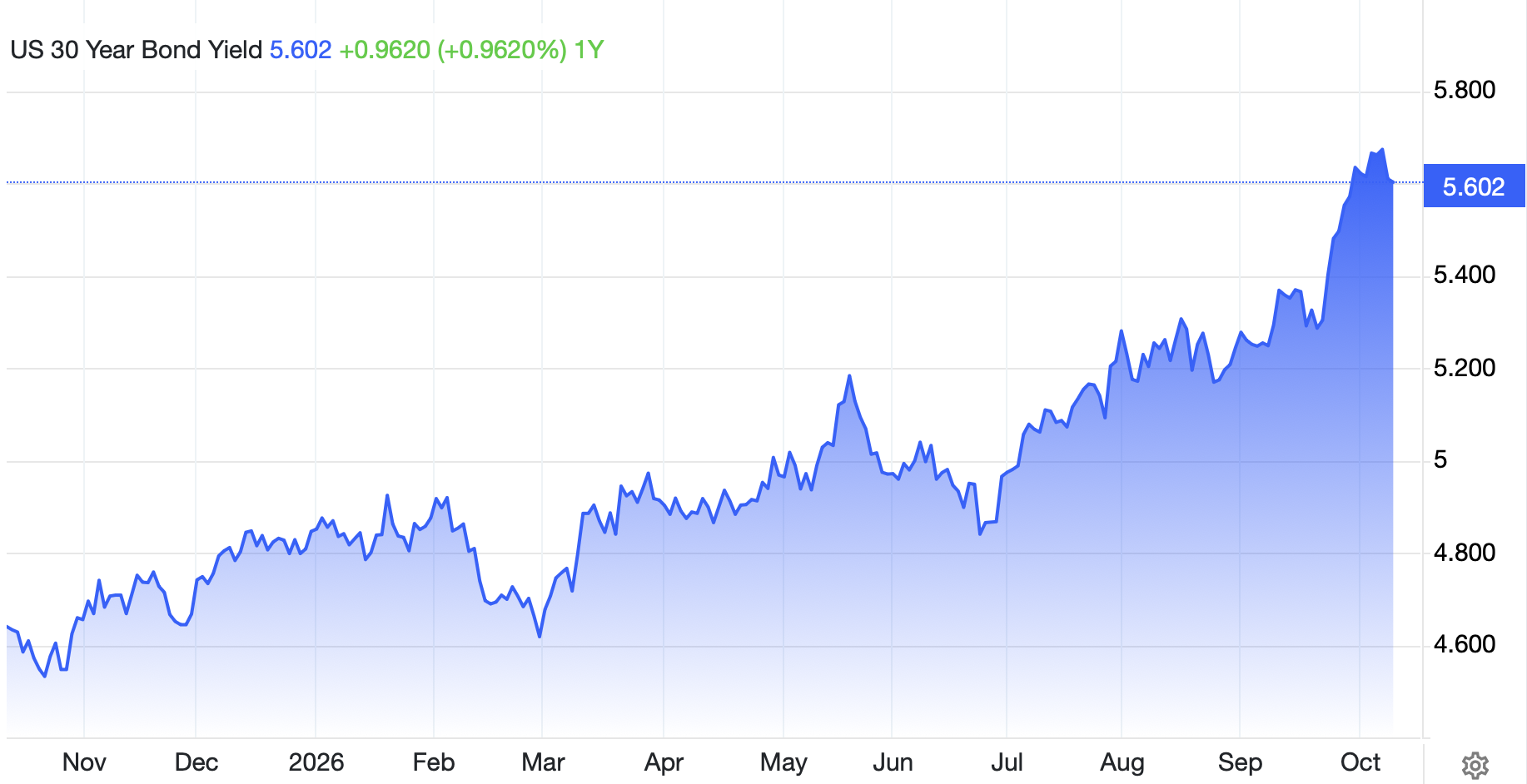
US 30Y Bond Yield, Tradingeconomics Last Wednesday, a $39 billion Treasury auction took place. This is worth noting because demand was solid, bids came in around 2.77 times the amount on offer, and indirect bidders (investors that submit bids through a bank or a primary dealer instead of bidding directly themselves) this can include foreign investors, retail traders, who took around 80.3% of the auction. Leaving primary dealers with just 2.5% of the award. 6.3 points less than the average. Primary dealers: our buyer's last resort. The real money took almost everything. This is worth highlighting because in previous issues I mentioned the idea that nobody wants U.S. debt and highlighted some key reasons, but after this auction, we can see that this is partially not true. Investors are still buying, but due to the move from around 3.9% to above 5.3%, they are just demanding a higher return to hold debt in such an uncertain period. This coming week:
US Equities S&P +1.23%, Nasdaq +0.60%, Dow +0.90%, Russell -0.9% Pretty big news in the upcoming week. Six major Wall Street banks (J.P. Morgan, Wells Fargo, Citigroup, Goldman Sachs, Bank of America, and Morgan Stanley) are all announcing early earnings, and the bar is already set high. Last quarter, Goldman beat their existing per-share expectations by 45%, so now investors will be looking closely to see if another strong quarter is repeated. They'll be looking to answer the question of whether big banks can keep high profits while borrowing costs increase. The CEO of J.P. Morgan, Jamie Dimon, has also repeatedly spoken out about the economy and its health. So watch these earnings closely, and maybe some answers will start flowing in. Global Did we say goodbye to sanctions? Trump announced that he and Putin made a deal: Russia will supply diesel to American and global markets. The first shipment is expected to be around 300,000 metric tons, which converts to about 2.25 million barrels of diesel. Trump added a further 500,000 tons for November, and then around 1 million tons, and potentially another 3 million tons. President Zelensky spoke out, saying this was a "Gift to Putin." The market was quick to react, diesel down around 4%, but Brent barely moved. This is critical to notice because diesel can help with the shortage in refined fuel, but it won't help as much with the global energy shock as the wider crude supply problem. UAE/Gulf DeskTwo Fronts, One GulfHenry de Salis Another week, another barrage of volatility for Gulf markets to swallow – last Thursday brought about a hard sell off across the region, driven by attacks in Hormuz hitting a wartime high, and the Houthi campaign turning deadly against Saudi. While the word 'resilience' is one that the macro scene seems to keep hearing, that's gone quiet in the Gulf, where economic data added to the gloom. On the upside, markets digested deeper integration between the UAE and Saudi, alongside developments from SoftBank and QNB. 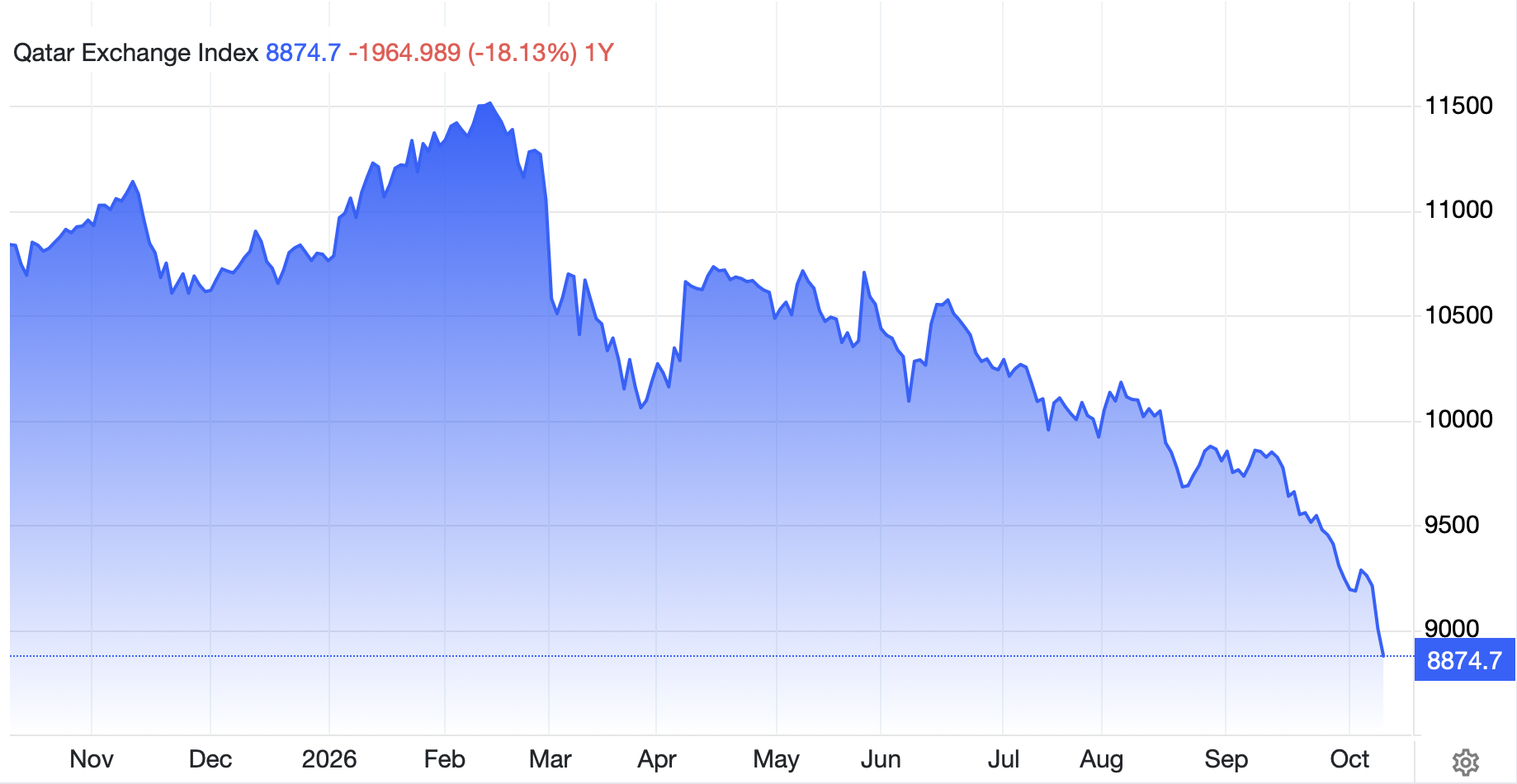
Qatar National Stock Index (QE General), Tradingeconomics Hormuz boils over, again Attacks on tankers in the strait reached a wartime high, just as Gulf producers were pushing to export more. The attacks are also spreading: vessels are being struck beyond Hormuz, with Qatar and the UAE in the crossfire. To add to the great news, flows through the strait fell below 10 million barrels a day, down from 15.5 million in September. A roughly 30% reduction in oil flows just wasn't enough for markets however – the Houthis opened a front over Saudi Arabia. On Saturday, at least 12 people were killed and 309 injured at Riyadh's primary airport, with over 260 flights cancelled. GCC Squeezed Together This week, Saudi and the UAE acted as a pair, signing an MoU on grid interconnection, power trading, and cross-border freight rail. In the same nature, both experienced the Thursday sell-off, with Saudi Arabia and Abu Dhabi falling 1.6%, Dubai 1.7%, and Qatar 2.2% to its lowest level since 2020. Abu Dhabi reported UAE GDP contracting 2.1% in Q2, further adding to the broader sentiment. SoftBank however, has moved ahead, looking for $100B from Gulf investors for a new AI fund. The Qatar National Bank (QNB) secured a $2.5B loan, upsized on strong demand, with its Q3 profit beating expectations. America Owns The Outlook The Pentagon told CENTCOM to finish preparations for possibly resuming major combat operations against Iran, and Trump is currently weighing throwing American weight behind Saudi Arabia against the Houthis. The United States is in charge of both fronts simultaneously, and Gulf markets are waiting for what Washington decides to do. The outlook remains defensive and choppy, with risks tilted heavily to the downside, as oil prices fail to provide a windfall amidst shipping disruptions – the UAE is likely to lead in resilience, and Saudi and Qatar left most vulnerable. Gold It was a violent week for gold, but the week ended up seeing gold flat, at about $4,190 an ounce. The key development is that gold isn't trading as a war hedge; Houthi strikes on Riyadh, Brent at $105 would normally lift it, but this war is inflationary. A hawkish Fed and rising bond yield are tilting risks to the downside for gold, with the pace of central bank buying falling in H1 2026, and investors sold 45 tonnes through ETFs in Q2. Goldman Sachs sent the message loud and clear: a more hawkish Fed could trigger a sharper correction. With institutional wisdom suggesting the outlook is balanced, the US CPI on Wednesday will decide whether the Fed pauses or keeps hiking – and hence the near-term outlook on Gold. Read online at twodesksnewsletter.com This is not financial advice. Read our disclaimer.
Henry de Salis 
Copyright 2026 Two Desks. All Rights Reserved. |